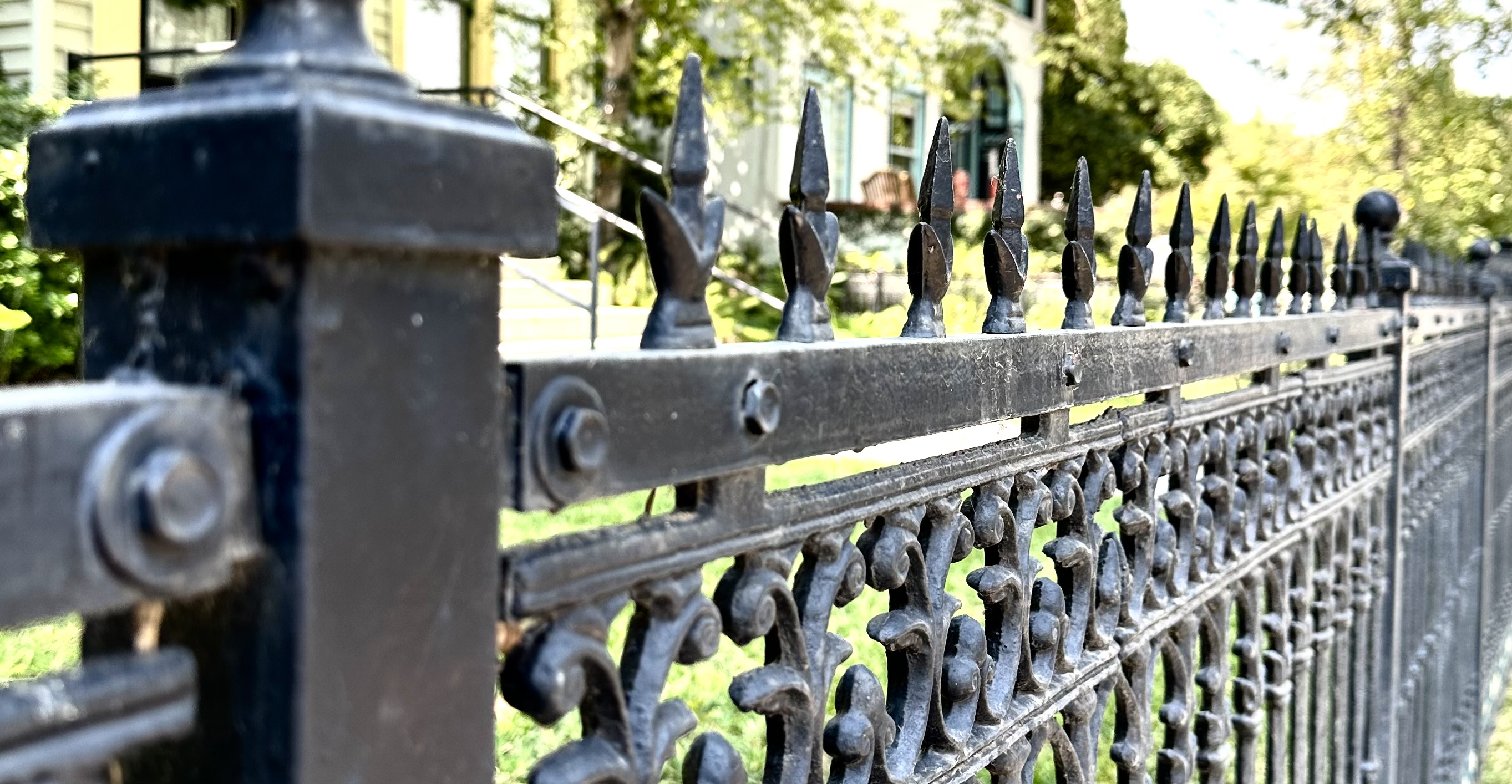
Rousseau's spiked fence was
    tall, ornate, intricate,
a cast-iron invitation
    to a gracious impalement.

Education must, said he,
    let the child choose
to walk that fence,
    to learn not to walk that fence.

Skipping along its ridge
    is an ecstasy of defiance,
and tripping, a humiliation
    of pain and scars.

The child is the child's
    teacher; there are no grades,
though the dead perforce
    will fail the course.
The "Child on a fence"
example is apocryphal
and probably the most
famous quote Rousseau
never said. It is an
extrapolation of his
theory of childhood
education in his book
"Emile", arguing that
children must be allowed
to educate themselves.
Only by suffering the
consequences of doing
something unwise will
the child learn not to
do it, even if the act
of learning involves
discomfort or pain.
 Old folks die noisy deaths.
   This is not the received wisdom of youth
  	who firmly believe in the
  	silent slide to oblivion
 "He just closed his eyes,
  	and was gone!"
  	she gushed with a smile,
  As though describing a child's first steps.

 The truth is

 Great-aunts drop casseroles onto
   	hard kitchen floors,
  	as their chests burst,
  Widowers knock over tables
  	lurching from bed
  	clutching their throats,
  A farmer scolds his dog,
  	-- gone 40 years --
  	for chasing sheep,
  And the mother rips
  	tubes from her arms,
  	cursing the nurse
  		for poisoning her.
Part 2
 The dying man
  	hears the loudest noise.

 He carries from birth a
  	metal bowl into which drop
  	steel balls, at odd moments,
  		unexpectedly.

 He walks alone down a long
  	crystal arcade, lined
 	with glass cabinets.

 The bowl becomes heavy
  	and he grows frail.

 He pitches forward and the perfectly elastic
  	spheres bounce everywhere,
   	a cacophany of clack-clack-clack
  		and breaking glass.

  He lies, clinging to the sounds,
  	life oozing from his mouth
  	with each moan,
  Not fully gone
 	until silence follows
  	the last tap.